Linear stability as a tweezer phase is swept
Every system levisim models is a network of damped linear resonators, \(\dot{\hat{\mathbf c}} = \mathbf A
\hat{\mathbf c} + \hat{\mathbf c}_\text{in}\), and it has a steady state only if every eigenvalue \(\lambda\) of
the drift matrix \(\mathbf A\) has \(\mathrm{Re}\,\lambda < 0\). The stationary spectra do not show it when
this fails: they remain finite numbers. MultiTrap therefore reports its stability explicitly
(is_stable, max_growth_rate, unstable_modes, drift_eigenvalues) and logs a WARNING for an
unstable system. The theory is on the concepts page
Eigenvalue stability of coupled resonators, and the guide page
Linear stability of a system lists which ready-made systems are unstable.
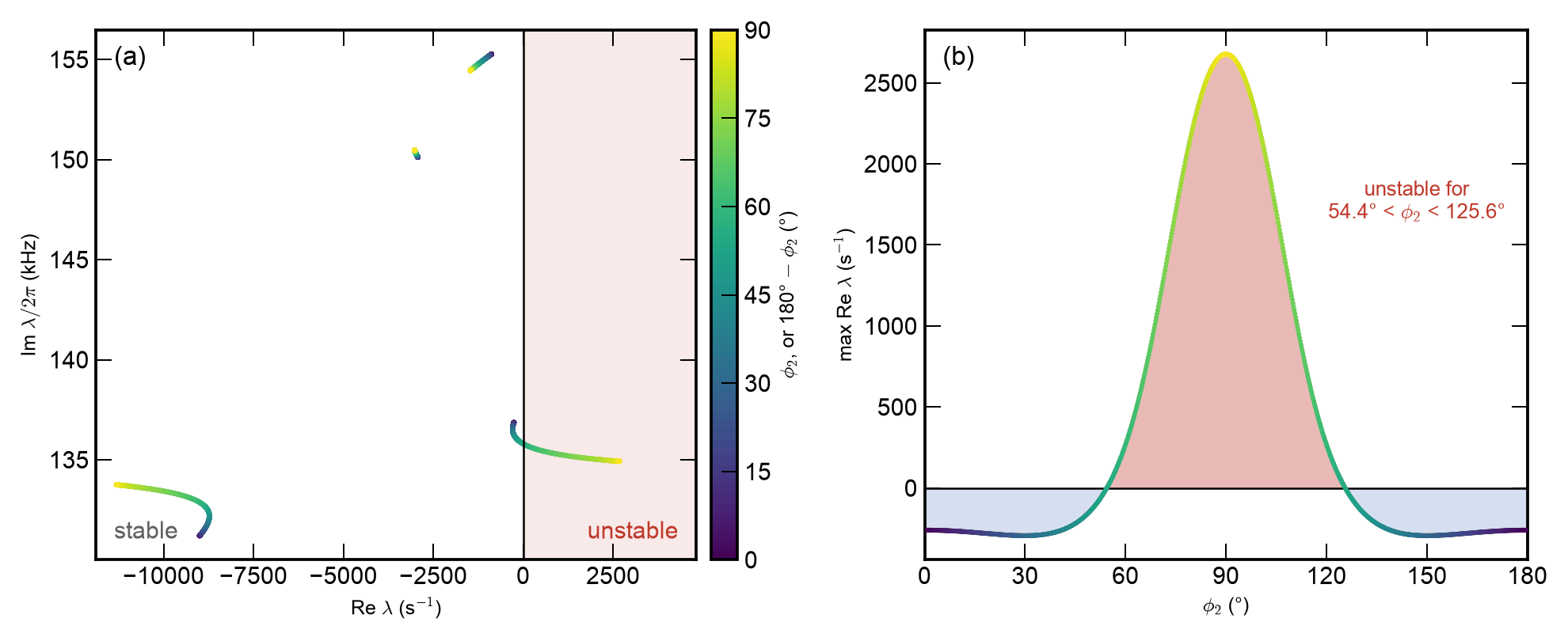
The README quickstart system (two particles moving in \(x\) and \(y\), levisim’s default tweezers, beads, cavity and gas) with the second tweezer’s phase \(\phi_2\) swept from 0° to 180°. With unequal phases the cavity-mediated coupling between the particles gains a non-reciprocal part \(\propto \sin(\phi_2 - \phi_1)\), which anti-damps the hybridised pair of \(y\) motions. (a) The mechanical eigenvalues in the complex plane for \(\phi_2\) from 0° to 90°; the eigenvalues at \(\phi_2\) and \(180° - \phi_2\) are the same, so this covers the whole sweep. One mode near 135 kHz crosses into the unstable half-plane. (b) The largest growth rate: the system is unstable for \(54.40° < \phi_2 < 125.60°\) (edges found by root-finding), with \(\mathrm{Re}\,\lambda = +2.68 \times 10^3\) s⁻¹ at 90°, the built-in phase of the second tweezer, which is why the quickstart uses \(\phi_2 = 30°\) (\(\mathrm{Re}\,\lambda = -294\) s⁻¹).
def compute(quick=False):
    """Mechanical drift eigenvalues [s⁻¹, rad/s] and max Re λ for φ2 over 0-180°"""
    quiet_console()
    φ2 = np.arange(0, 180.0001, 2.0 if quick else 0.2) * degrees
    eigenvalues, growth = [], []
    for φ in φ2:
        mtrap = two_particles(φ)
        λ = mtrap.drift_eigenvalues
        mechanical = λ[(λ.imag > 0) & (λ.imag < 300 * kHz)]  # positive-frequency mechanical modes
        eigenvalues.append(np.sort_complex(mechanical))
        growth.append(mtrap.max_growth_rate)
    return dict(φ2=φ2, eigenvalues=np.array(eigenvalues), max_growth_rate=np.array(growth))
The static version of the figure, as shown in the README.