Sensing a directional noise bath (PRR 6, 2024)
J. M. H. Gosling, A. Pontin, J. H. Iacoponi, P. F. Barker and T. S. Monteiro, Sensing directional noise baths in levitated optomechanics, Phys. Rev. Research 6, 013129 (2024), doi:10.1103/PhysRevResearch.6.013129.
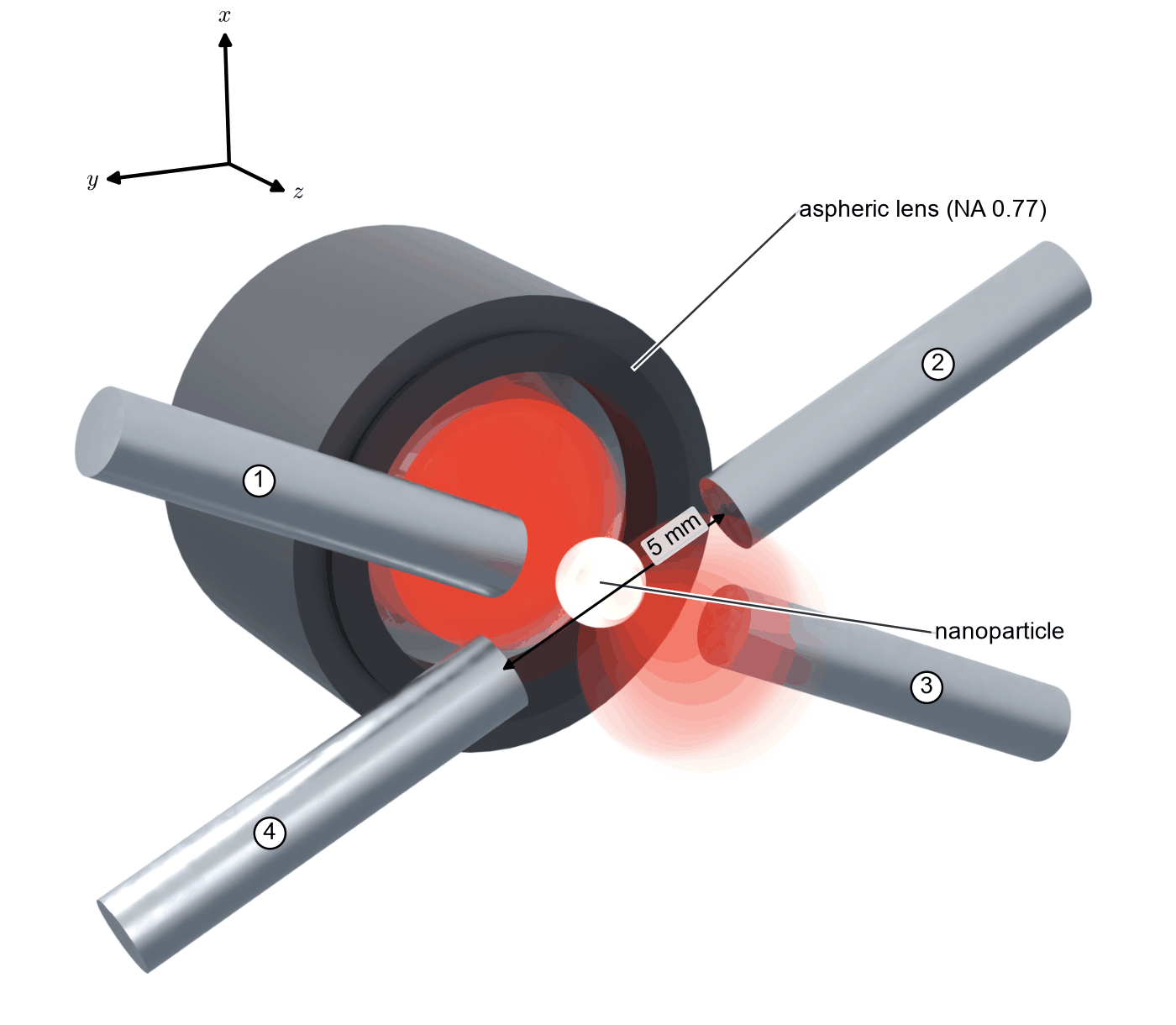
The particle is trapped at the focus of an aspheric lens (NA 0.77) between four electrodes, which apply a white-noise force along a chosen direction \(\psi\) in the \(x\)-\(y\) plane.
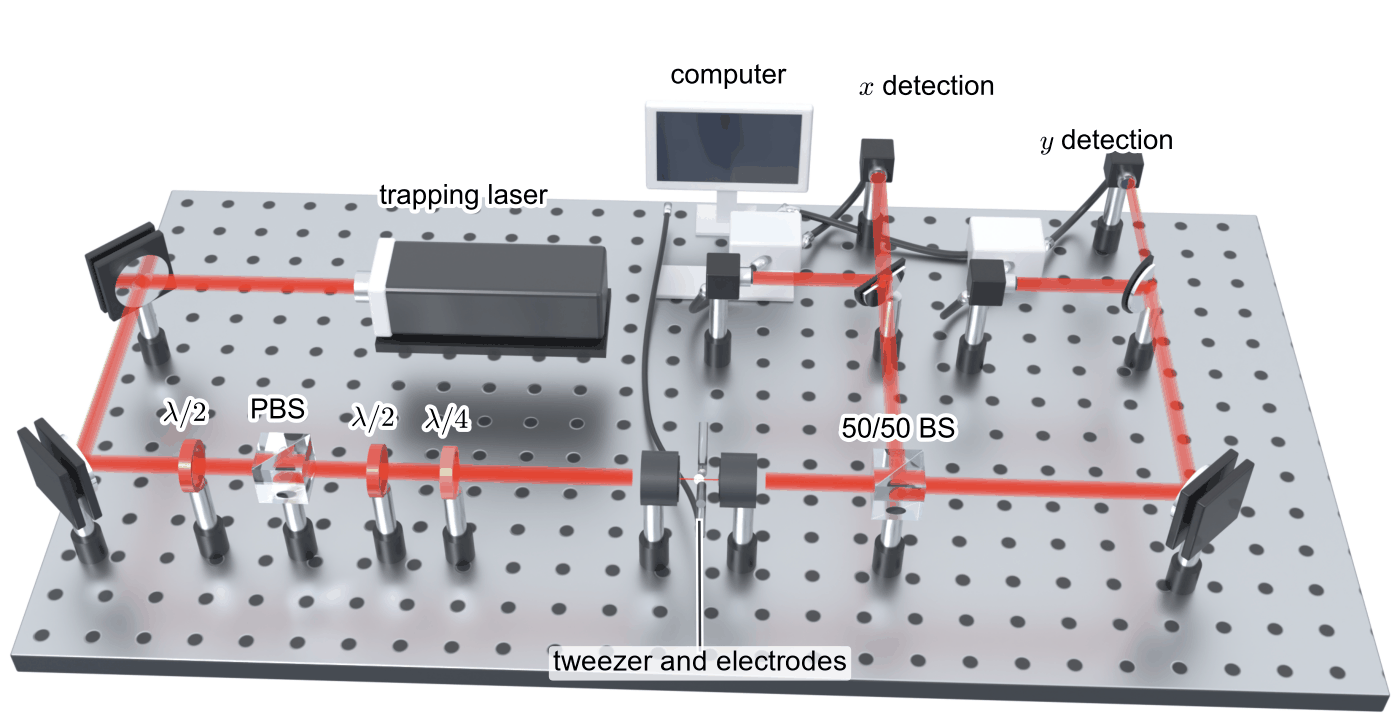
The table: the trapping laser and its polarisation optics, the tweezer and electrodes, and the balanced detection of \(x\) and \(y\).
A stream of impulses too weak to detect one by one, arriving from a fixed direction, acts on a
levitated particle as a white-noise force along that direction. Its power spectral densities only
show it as extra heating, which must be separated from the thermal part by a calibration, and which is
the same for \(\psi\) and \(-\psi\). In this paper we showed that the \(x\)-\(y\) cross-correlation spectrum is a
calibration-free signature of such a force and of its quadrant, since uncorrelated thermal noise
leaves \(S_{xy}\) at zero on average. I simulated all of it in levisim: the directed force enters the
stochastic Runge-Kutta integration of Simulation as one random force shared between \(x\) and \(y\) in
proportion to \(\cos\psi\) and \(\sin\psi\), and I worked out the error analysis of the spectral estimates in
the paper’s appendix.
The default free-space Trap (485 mW at 1064 nm, a 60.1 nm sphere, \(4 \times 10^{-3}\) mbar, feedback
damping \(\Gamma_{\text{fb},x}/2\pi = 2.1\) kHz and \(\Gamma_{\text{fb},y}/2\pi = 2.5\) kHz) with a directed force
twice the thermal force PSD (\(\beta = \sqrt{2}\)). Points are one seeded 40 ms simulation per angle,
averaged over 40 segments; lines are SpectralDensityTheory. (a) \(S_{xx}\) and \(S_{yy}\), one-sided:
the directed force raises them above the thermal-only spectra (shaded) by the same amount for
\(\psi = +45°\) and \(-45°\). (b) The co-spectrum \(C_{xy} = \mathrm{Re}\,S_{xy}\) changes sign with \(\psi\):
its lobes, \(\pm 4.3 \times 10^{-23}\) m²/Hz near each resonance (\(\Omega_y/2\pi = 135.8\) kHz,
\(\Omega_x/2\pi = 156.3\) kHz), tell the quadrant of the force directly.
The essential lines:
def compute(quick=False):
    """Seeded simulations at ψ = ±45° and their theory curves, one-sided, in m²/Hz"""
    quiet_console()
    num_samples, num_segments = (50_000, 10) if quick else (400_000, 40)
    data = {}
    for ψ in ANGLES:
        trap = Trap(ψ=ψ * degrees)   # β = √2: directed force twice the thermal force PSD
        sim = Simulation(trap=trap, num_samples=num_samples, Δt=0.1 * μs, seed=2024)
        estimates = {ij: SpectralDensityEstimate(sim, ij, num_segments=num_segments) for ij in ('xx', 'yy', 'xy')}
        f = estimates['xx'].freq_range
        band = (f > BAND[0]) & (f < BAND[1])
        data[ψ] = {ij: np.real(est.values[band]) for ij, est in estimates.items()}
        data[ψ]['f'] = f[band]
    f_theory = np.linspace(*BAND, 1500)
    ω = 2 * np.pi * f_theory
    data['f_theory'] = f_theory
    for ψ in ANGLES:
        theory = Trap(ψ=ψ * degrees).theory
        data[f'theory_{ψ}'] = dict(xx=theory.Sxx(ω), yy=theory.Syy(ω), xy=theory.Cxy(ω))
    thermal = Trap(β=0.0).theory   # same cooling, no directed force
    data['thermal'] = dict(xx=thermal.Sxx(ω), yy=thermal.Syy(ω))
    return data
The model, the Kasdin noise weights of the stochastic integrator, and the estimator options are in the guide page Stochastic simulations of a bead in a free-space tweezer.
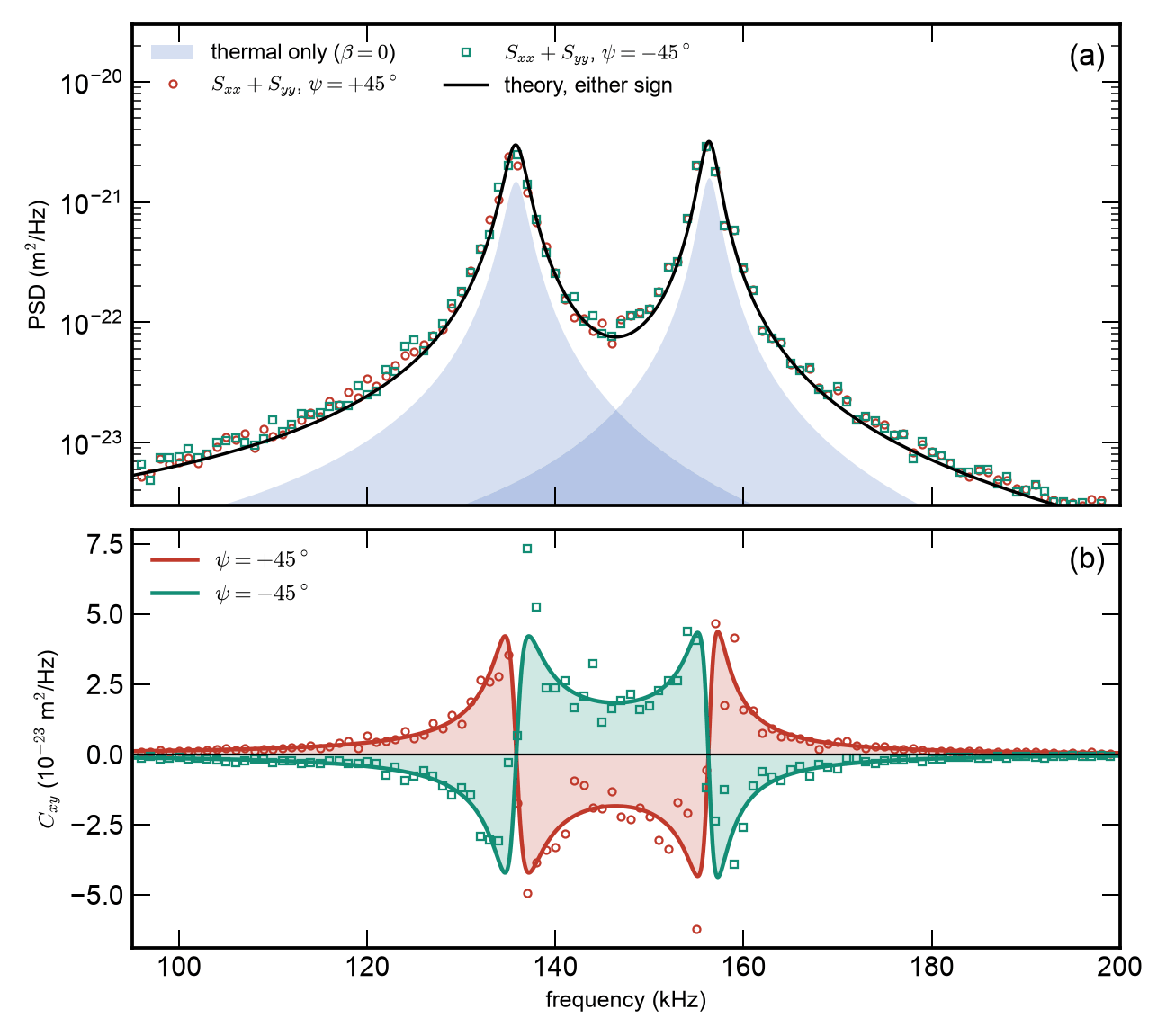
The static version of the figure, as shown in the README.