A mechanical mode comb and its collective bright mode (PRR 8, 2026)
J. H. Iacoponi, M. Rademacher and T. S. Monteiro, Nanoparticle arrays levitated in a cavity for quantum sensing, Phys. Rev. Research 8, 033286 (2026), doi:10.1103/wrd3-t5cf.
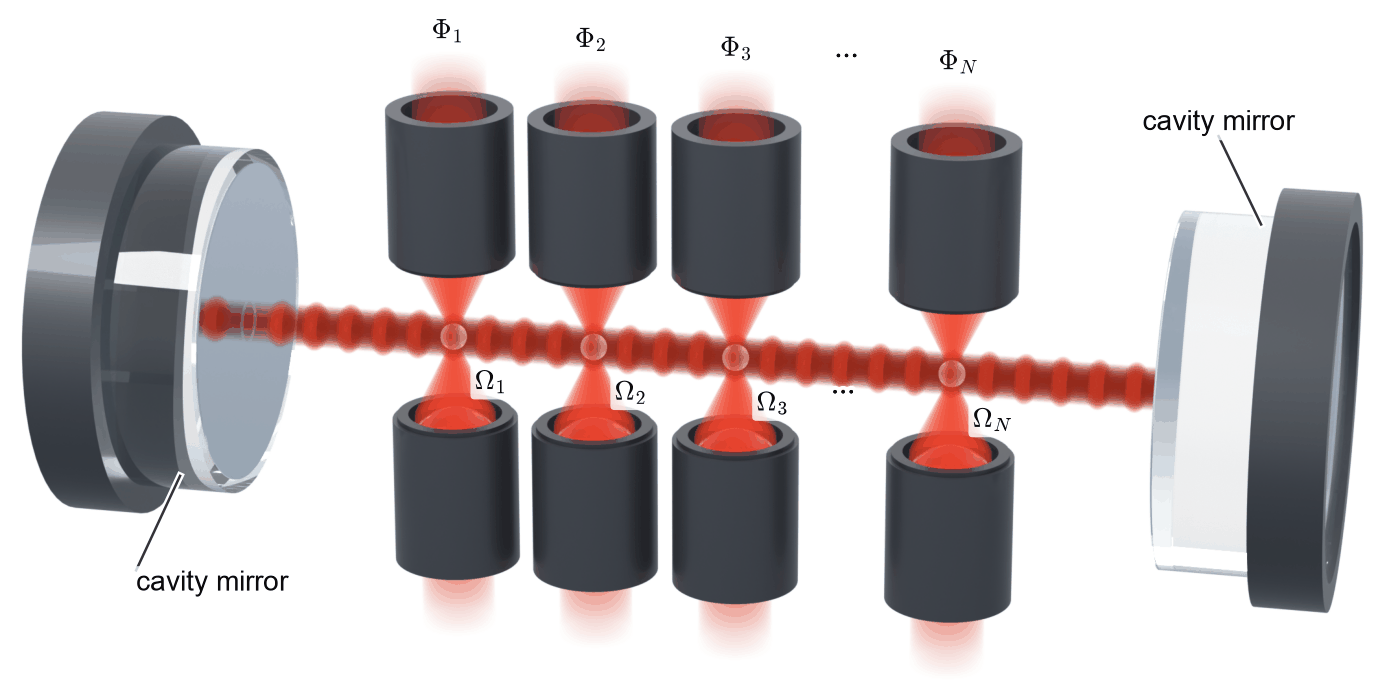
\(N\) tweezers along one cavity mode, each with its own phase \(\Phi_n\), trap particles whose motions have frequencies \(\Omega_j\).
When many particles share one cavity mode, the light couples every motion to every other. In this paper we treated such arrays with the quantum linear theory, found closed forms for the spectra in terms of the tweezer phases, and showed that a comb of evenly spaced mechanical frequencies is reorganised by the cavity into one collective bright mode, which takes almost all of the coupling to the light, and a comb of nearly dark modes, which stay close to the bare frequencies and keep their narrow linewidths. levisim calculates everything in the paper; its analytic methods (6) and (7) are the paper’s closed forms.
\(N\) particles, each moving in \(x\) and \(y\), at the node of the default cavity (\(\Delta/2\pi = -450\) kHz, \(\kappa/2\pi = 390\) kHz, \(10^{-6}\) mbar), with \(2N\) mechanical frequencies spaced 6.67 kHz apart about 300 kHz and \(g/2\pi = 40\) kHz for every motion (toy parameters, as in the paper’s Fig. 1). (a) The heterodyne spectrum of the cavity output for \(N = 8\): the comb of 16 narrow peaks at the bare frequencies, and the bright mode as a broad feature far below them. (b) Every mechanical eigenfrequency of the drift matrix against \(N\), coloured by its linewidth \(\Gamma/2\pi\) (\(-2\,\mathrm{Re}\,\lambda/2\pi\)); the grey bars are the spans of the bare frequencies. The bright mode moves from 286.7 kHz for one particle to 156.9 kHz for eight, broadening from 17.4 kHz to 90.8 kHz, while the narrowest dark mode narrows from 0.84 kHz to 0.42 kHz. All eight systems are linearly stable; with these couplings the bright mode reaches zero frequency (a static instability) for \(N = 12\).
The essential lines:
def array(N, ω_range=np.arange(100, 400, 0.05) * kHz):
    """N particles (x and y each), 2N frequencies evenly spaced about 300 kHz, g/2π = 40 kHz"""
    return MultiTrap(
        num_traps=N,
        Cartesian_axes_per_trap=2,
        gas_kwargs=DEFAULT_gas_kwargs,
        cavity_kwargs=DEFAULT_cavity_kwargs,
        toy_params=dict(
            Ω_model='equal spacing', Ω_mid=300 * kHz, Ω_span=SPACING * (2 * N - 1) * kHz,
            toy_gx=-40 * kHz, toy_gy=-40 * kHz,
        ),
        ω_range=ω_range,
    )
def mechanical_modes(mtrap):
    """(frequency [kHz], linewidth Γ/2π [kHz]) of each mechanical normal mode, without the cavity-like one"""
    λ = mtrap.drift_eigenvalues
    modes = sorted(((abs(l.imag) / kHz, -2 * l.real / kHz) for l in λ if l.imag > 0), key=lambda m: m[1])
    return modes[:-1]  # the broadest is the cavity-like eigenvalue (Γ/2π ≈ κ/2π)
The paper’s figures themselves are recomputed in the research notebook
notebooks/multiphysics/mechanical-mode-comb/reproduce_Figs_1_3_4_5.ipynb.
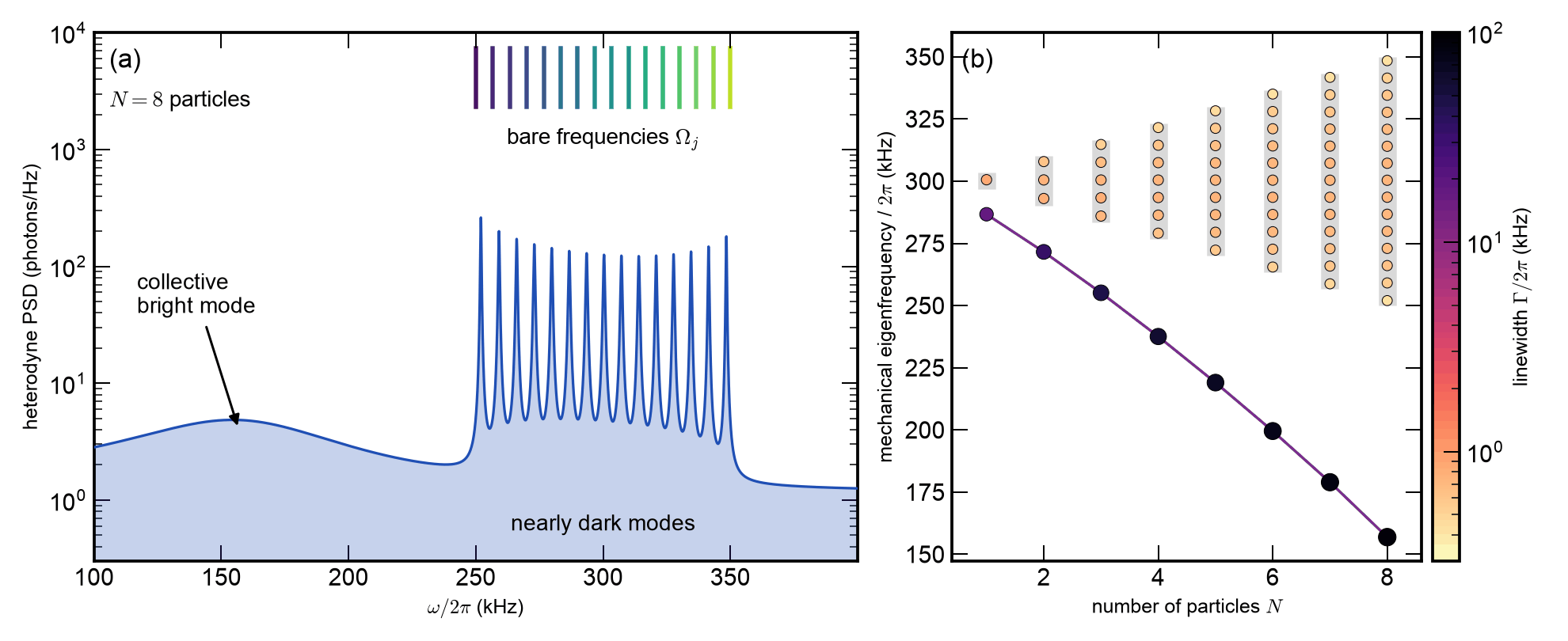
The static version of the figure, as shown in the README.