levisim
levisim simulates levitated optomechanics. Its core is the quantum linear theory (QLT) of
several optically levitated nanoparticles coupled by coherent scattering to one shared cavity
mode: given the traps, the gas and the cavity, it calculates the homodyne and heterodyne spectra
of the cavity output and the power and cross spectral densities of every particle’s motion, by
any of seven calculation methods that can be checked against each other. Around that core it has
a stochastic simulator of a bead in a free-space tweezer, covariance-matrix tools for
steady-state entanglement under a two-tone drive, and a Fortran reference implementation that the
Python spectra are tested against.
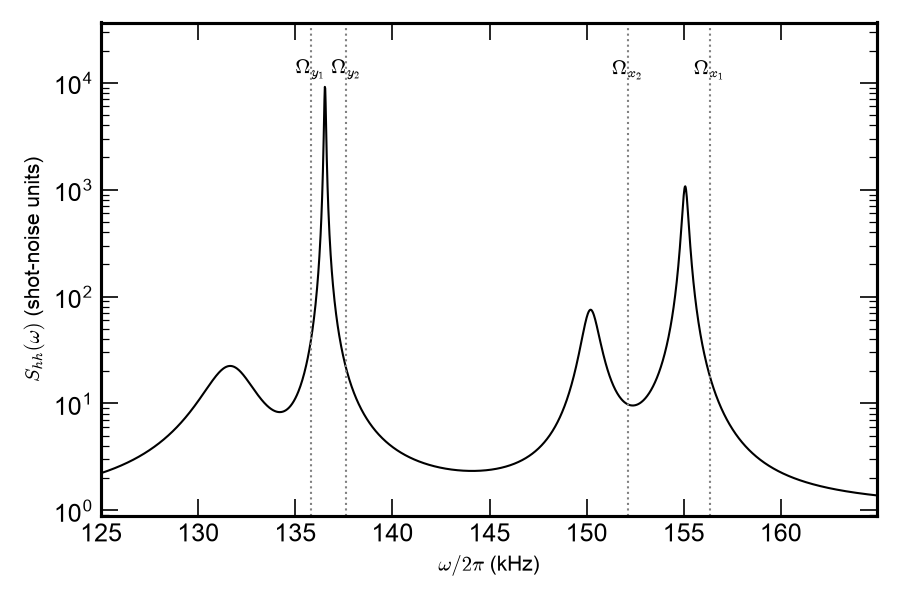
Homodyne spectrum of the cavity output for two particles moving in \(x\) and \(y\) (the quickstart). Dotted lines mark each motion’s bare trap frequency \(\Omega_{j_n}\).
Using levisim
- Getting started
- Interactive 3D web labs
- Showcase: three papers, and stability
- The system and its conventions
- Calculation methods
- Eigenvalue stability of coupled resonators
- The linearised Langevin equations and the drift matrix
- Eigenvalues are normal modes
- The stability criterion
- Why the stationary spectra cannot reveal an instability
- Two coupled modes: avoided crossings, level attraction and exceptional points
- Non-reciprocal coupling through the cavity
- Other systems the same machinery describes
- References
- User guides
- Spectra of several particles in one cavity
- Linear stability of a system
- Stochastic simulations of a bead in a free-space tweezer
- Logging
- Steady-state entanglement of a particle’s two transverse motions with a two-tone coherent-scattering drive
- Two-tone traps: polarisation, mech-mech coupling, the node, and a second particle
- Notebook gallery
Reference
Development